

Choosing art for your workplace: build a selection with a clear thread

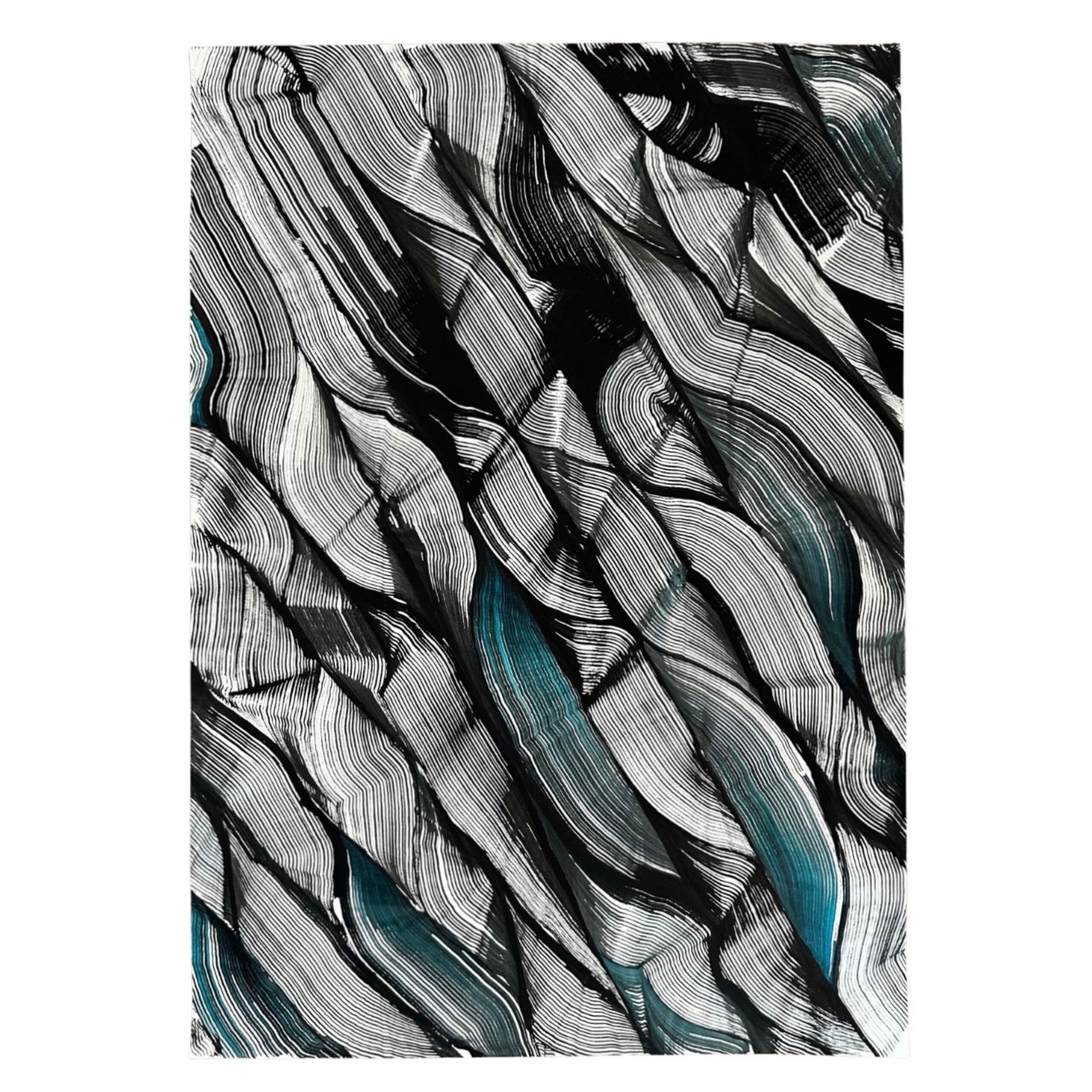
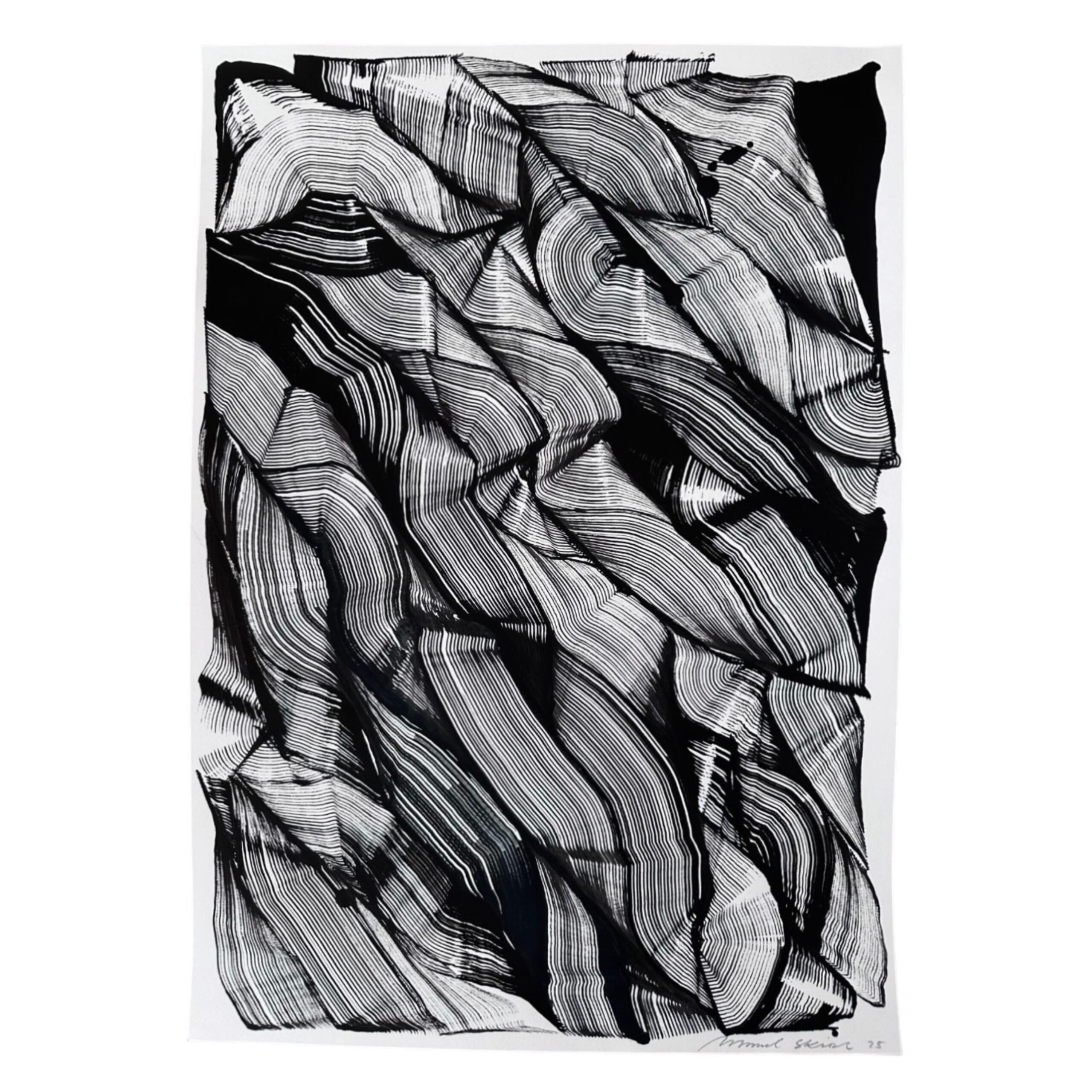
Blue-green passages slip between the black and white lines of Manuel Skirl’s RESIDUUM. In EINHEIT, a similarly dense pattern reads more monochromatically. The resemblance is easy to spot. The differences give a business owner something useful to consider: how can several works belong together while each keeps its own presence?
A workplace selection begins with that relationship. Counting empty walls can wait.
In brief
Choose a thread you can explain through the works themselves: a recurring kind of mark, a material, a question or a deliberate contrast. Give each proposed addition a reason to belong. A distinctive office can begin with a small selection and room to grow.
A connection you can point to
For a concrete starting point, consider these two works in the Dumas catalogue. Both are listed as acrylic on paper, dated 2025, with framing noted. Their fine, curving lines gather into larger overlapping shapes. Look at the individual marks, then let your eye follow the whole surface.
Discover Manuel Skirl
View RESIDUUM and purchase information
Discover Manuel Skirl
View EINHEIT and purchase information
The gallery’s introduction to Manuel Skirl describes his use of a hand-cut roller. It offers context for a practice with a recognisable visual vocabulary, without making every composition interchangeable.
For an office project, this suggests a precise selection question: do you want to follow the variations within one artist’s work? That is a more useful brief than asking for something contemporary to suit the furniture.
Similarity needs a little resistance
RESIDUUM’s blue-green passages and EINHEIT’s stronger black-and-white impression offer a possible relationship to explore. On a shortlist, ask what each contributes that the other does not. If the answer is only that another wall needs filling, keep looking.
A shared artist can give a selection continuity. It need not become a rule for every later purchase. Another artist might bring a different material or treatment of line; the connection should remain visible when you explain it without mentioning the office colour scheme.
This also helps when colleagues have different preferences. Invite them to describe what they notice in each proposed work. Those observations give the decision-maker more to work with than a quick vote on a favourite thumbnail.
The gallery’s eye: leave space for a stronger choice
One way to read this pair is repetition with variation: related marks, differently gathered. For a workplace, that could support a selection that feels connected across several rooms without requiring identical images everywhere.
It may also lead you to choose just one. A coherent selection grows through omissions as well as additions. Keep a short note explaining why a work belongs, and return to it when the next proposal arrives.
Examine RESIDUUM · Compare EINHEIT
Discuss the selection as a whole
Bring your shortlist, photographs of the spaces and a budget range. Include works already in the office: a new acquisition has neighbours. Galerie Dumas describes guidance for corporate collections in its Art Advisory introduction.
Arrange a gallery visit to discuss a coherent workplace selection
If you would like to see these particular works, ask whether they can be viewed on your chosen date. Their artwork pages are also available directly; a conversation is optional support.
Discover Manuel Skirl
View RESIDUUM and purchase information
View EINHEIT and purchase information
Before sharing room photographs, remove people, client details and confidential information from view.
Related posts


