A new acquisition, a new conversation in your collection

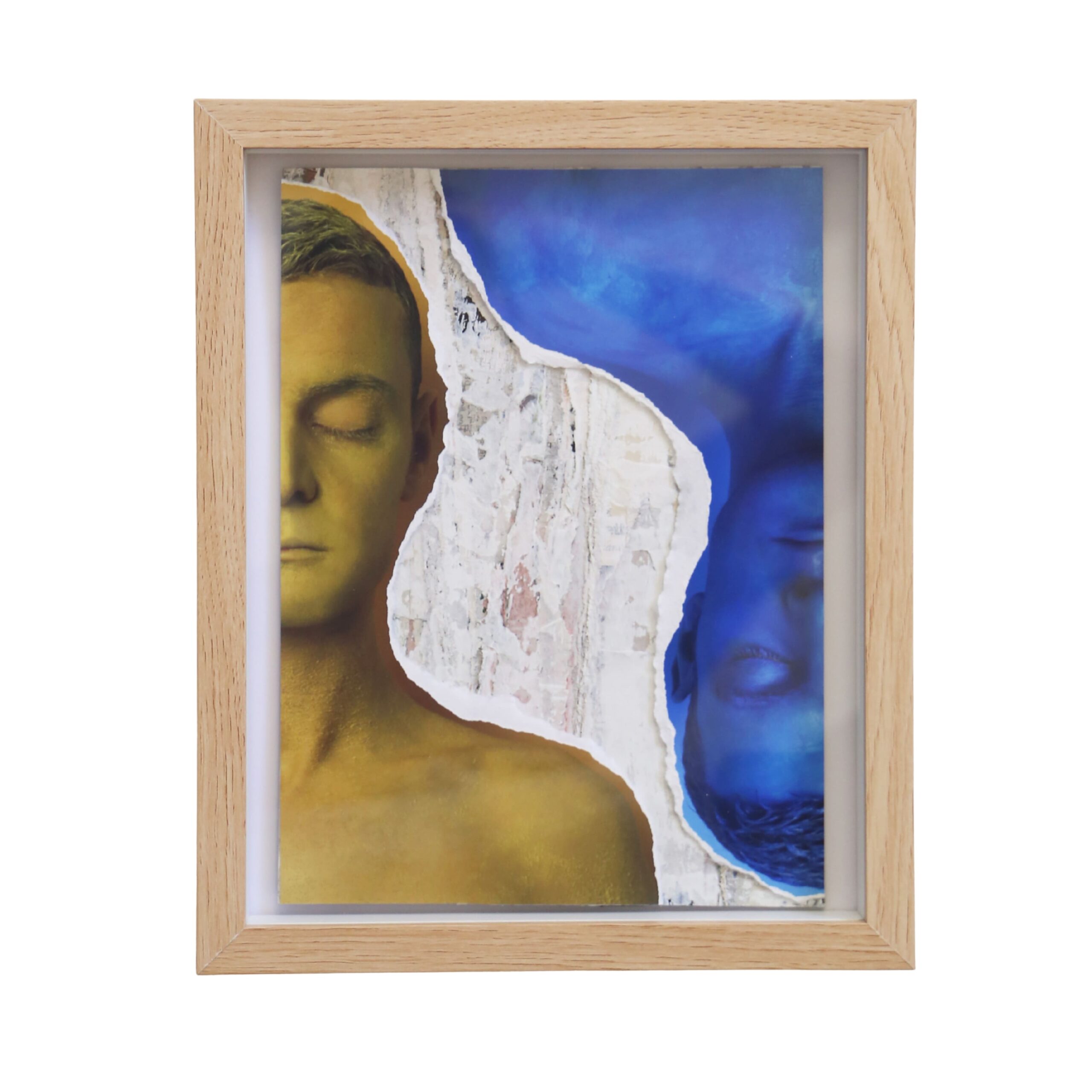
A yellow face stands upright on the left; a blue face turns upside down on the right. In Exposito’s JAUNE & BLEU, a pale, irregular band separates the two. For a collector considering what comes next, that divided image offers a useful starting point: which work already in your collection might make you look at it twice?
An acquisition can deepen a connection you have been following for years, or introduce a difference that makes familiar works newly interesting. Coherence begins with a relationship you can name. A matching palette alone may leave you with very little to say.
In brief
Consider a new work beside one specific piece you own. Identify a shared feature, then the difference that keeps the pairing interesting. Look at scale and viewing distance before deciding whether that relationship holds beyond a screen.
Begin with a work you know well
Choose an existing piece you still return to, rather than the empty space you would like to fill. Describe what holds your attention: the way a face meets your gaze, perhaps, or a composition built around a sharp division. This gives the next acquisition something precise to respond to.
Galerie Dumas lists JAUNE & BLEU as a 2024 work in mixed media on cardboard, measuring 25 x 20 cm. The gallery’s introduction to Exposito describes self-portraiture combined with geometric shapes and colour as central to his practice. Those are two possible connections to explore, depending on what your collection already contains.
With a portrait, you might compare the treatment of the face. With a geometric work, the interest might lie in how a recognisable figure sits within a divided composition. These are possible pairings to consider, not a claim that every portrait belongs beside every abstraction.
The gallery’s eye: let the difference matter
One way to read the image is this: in JAUNE & BLEU, the change of orientation gives the two coloured faces different roles. The pale division also asks for attention; the eye has to move around it to compare them.
Beside a frontal portrait, that inversion could make an otherwise familiar subject feel less settled. Beside a work with clean geometric boundaries, the irregular edge could bring a useful friction. The reason for choosing it would then be more specific than finding another blue.
Try putting the relationship into one sentence. If that sentence describes only the colours, spend longer with the images. If it explains how each work changes your attention to the other, you have something worth pursuing.
Meet Exposito
View JAUNE & BLEU in the shop
Give the relationship room
At 25 x 20 cm, the listed work calls for a different comparison from a large painting. Images displayed at equal size on a laptop can disguise that difference. Consider the actual dimensions and the distance from which you would look; a promising connection need not require an adjacent hanging.
Galerie Dumas describes personalised art advisory for private collections. A conversation can begin with the work you own and the relationship you want to explore. Ask about seeing the candidate work, its current availability and framing details before planning an arrangement around it. Advice remains optional: the product page is also a direct route to the work.
Explore the connection
View JAUNE & BLEU and its catalogue details.
See visit information and contact Galerie Dumas to discuss how it might sit within your collection.
Related posts