

Choosing art for a reception area versus a meeting room

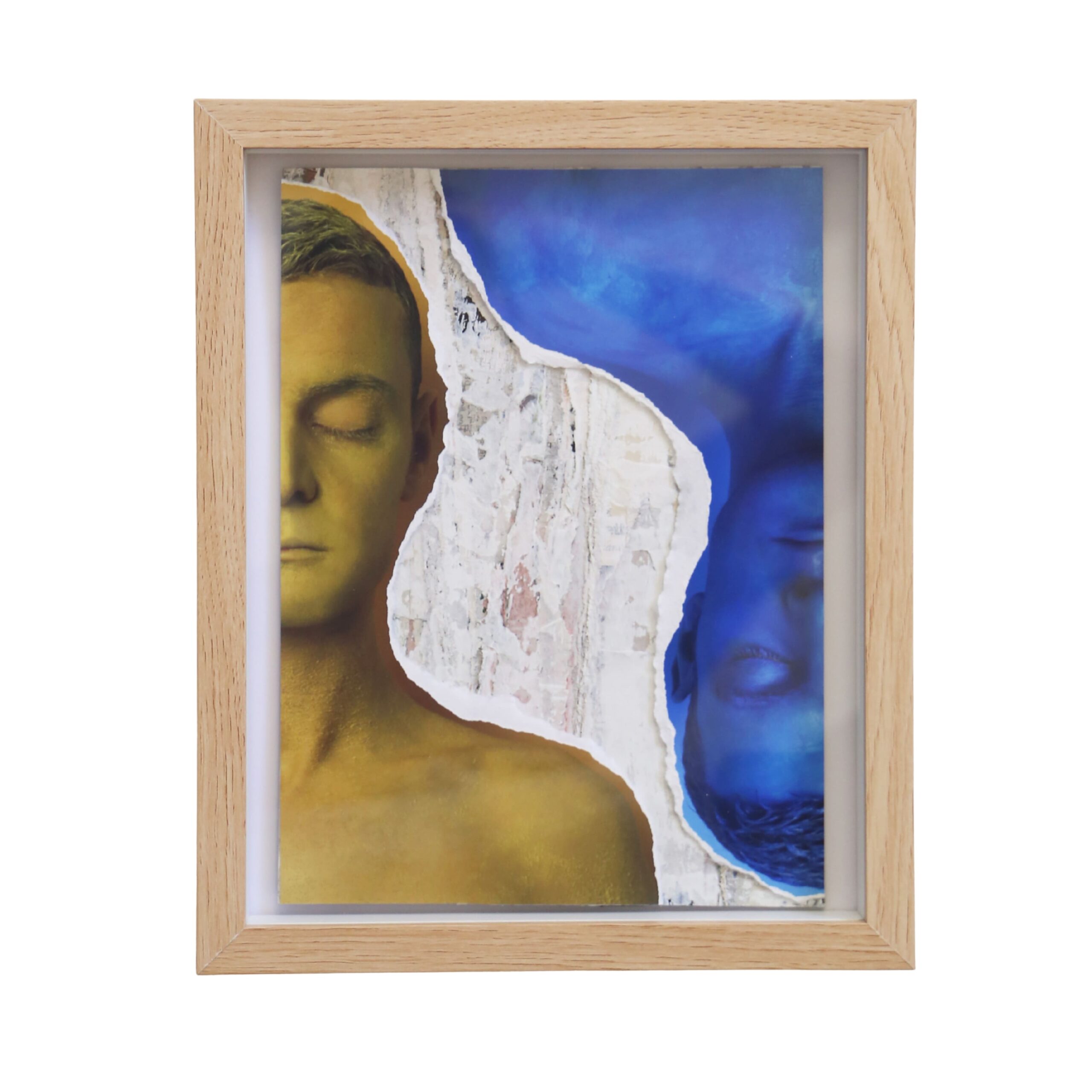
A work measuring 25 x 20 cm asks a useful question of an office wall: how close will anyone get? Exposito’s JAUNE & BLEU brings yellow and blue portrait fragments together across an irregular white divide. On a screen, the colours register immediately. In a room, distance becomes part of the choice.
For a business owner choosing art, reception and meeting rooms deserve separate briefs. Start with where people look and how long they stay, then consider which works reward that encounter.
In brief
Reception calls for attention to the approach and waiting position. A meeting room needs a check from the seats, alongside screens and other uses of the wall. Neither room has a compulsory artistic style: a small, layered work may belong in either, if people can actually see it.
Reception: follow the arrival
Imagine entering with a coat over one arm and an appointment to find. The first view of an artwork may be brief and oblique. Walk the route from the door, then sit where a visitor would wait. These can be quite different encounters with the same wall.
For JAUNE & BLEU, the catalogue’s modest dimensions matter. A position near waiting seats might allow a closer look at the face fragments and white edges. Across a broad lobby, much of that detail could be hard to read. Choosing a larger work is one possibility; choosing a more accessible wall is another.
Write the reception brief around that distinction: should the work address someone arriving, someone waiting, or both? Include a photograph from each position. A wall measurement alone leaves out the person looking.
Meeting room: take a seat before choosing
A meeting room keeps people in place for longer, though their attention may be on colleagues or a presentation. Check the proposed wall from the seats at both ends of the table. Include the screen in those views, even when it is switched off.
JAUNE & BLEU is catalogued as mixed media on cardboard, dated 2024. Its yellow upright face fragment and inverted blue fragment offer something to return to at close range. That makes it worth considering beside a small meeting table, rather than automatically assigning it to a distant end wall.
Check reflections and the view during a video call, too. A strong colour may appeal in person while becoming a conspicuous part of the camera background. The brief should describe which views matter to your room. Ask for placement advice appropriate to the actual work and materials before settling the position.
The gallery’s eye: try the same work in both briefs
One way to read Exposito’s practice is through the movement between a recognisable face and its reconstruction. Dumas’s artist introduction places self-portraiture at its centre. Here, the proposed room comparison turns on looking distance: a colour seen on arrival, then fragments noticed when seated nearby.
That is a way to consider the work, not a fixed assignment to a type of office. Keep enough room in the brief for an artwork to surprise you.
Discover Exposito
View JAUNE & BLEU and purchase information
Look more closely at JAUNE & BLEU and its catalogue details
Bring two room views to the conversation
Note the room’s use, wall dimensions, viewing positions and light, with photographs taken from the entrance or table. Galerie Dumas describes advisory support for corporate collections on its homepage.
Arrange a gallery visit to discuss your workplace brief
If you want to see JAUNE & BLEU in person, ask whether it can be viewed on your chosen date. You can also explore its artwork page directly; discussing a project is optional support.
Discover Exposito
View JAUNE & BLEU and purchase information
Before sharing room photographs, remove people, client details and confidential information from view.
Related posts


